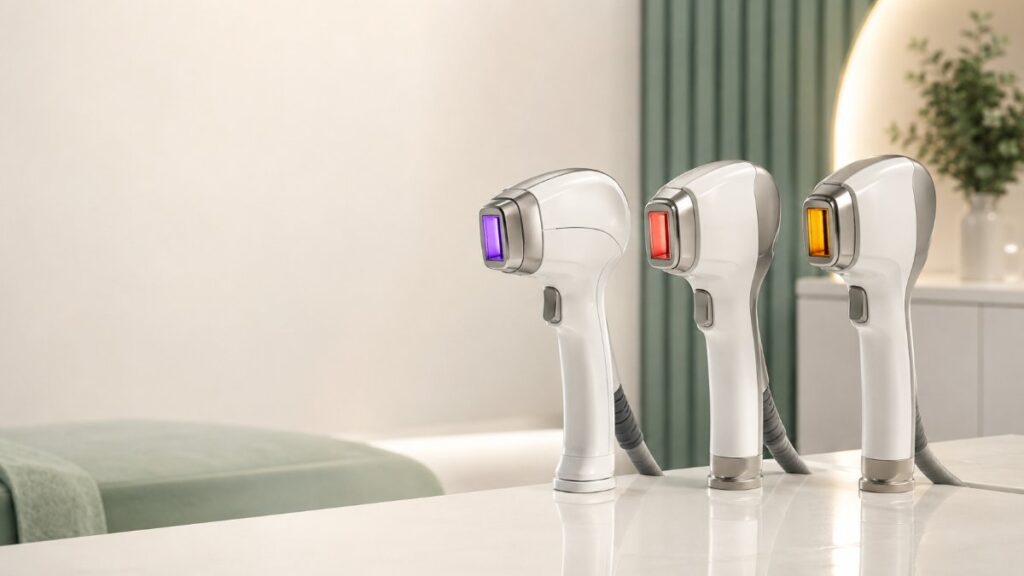
The best laser hair removal machine in India is not a single device it is the one matched correctly to your Fitzpatrick skin type. Alexandrite (755 nm) works best for fair skin Type I–III, Diode (810 nm) is the dependable workhorse for Type III–V, and Nd:YAG (1064 nm) is generally preferred for Type V–VI. Clinics that own all three switch between wavelengths based on what your skin actually needs.
The three main laser hair removal wavelengths
Laser hair reduction systems commonly use these three core wavelengths, which aim for long-term reduction rather than complete removal. Each targets melanin in the hair follicle during the anagen (growth) phase, but they differ in depth of penetration and how much they interact with the melanin in your surrounding skin.
1. Alexandrite laser 755 nm
The Alexandrite is the fastest and most melanin-hungry of the three. At 755 nm it has very high melanin absorption, which means it destroys fine and light hair efficiently but that same hunger for pigment makes it risky on darker skin, where it can burn the epidermis.
- Wavelength: 755 nm
- Depth of penetration: ~2 mm (shallow to mid-dermal)
- Melanin absorption: Very high
- Best for: Fitzpatrick I, II, III (fair to wheatish)
- Strength: Excellent on fine, light, stubborn facial hair
2. Diode laser 810 nm
The Diode is the workhorse of Indian dermatology clinics. At 810 nm it strikes a balance enough melanin absorption to destroy the follicle, but deep enough penetration (~3 mm) to bypass much of the epidermal pigment. It is used for many Indian skin tones, subject to assessment and is what you will see in most reputable practices.
- Wavelength: 810 nm (some platforms blend 755/810/1064)
- Depth of penetration: ~3 mm
- Melanin absorption: Moderate-high
- Best for: Fitzpatrick III, IV, V (wheatish to brown)
- Strength: Large treatment areas, coarse body hair, tanned skin
3. Nd:YAG laser 1064 nm
The Nd:YAG is the generally preferred laser for the darkest Indian skin tones. At 1064 nm it has the lowest melanin absorption of the three, so it bypasses surface pigment almost entirely and reaches the follicle bulb (~4–6 mm deep). It is generally the preferred wavelength for Fitzpatrick V–VI, in line with guidance from bodies such as the American Academy of Dermatology.
- Wavelength: 1064 nm
- Depth of penetration: ~4–6 mm (deepest)
- Melanin absorption: Low
- Best for: Fitzpatrick V, VI (deep brown to dark) and tanned skin
- Strength: Only safe option for darkest skin, also excellent on PCOS-related coarse facial hair and pseudofolliculitis
Comparison table Alexandrite vs Diode vs Nd:YAG
| Parameter | Alexandrite | Diode | Nd:YAG |
|---|---|---|---|
| Wavelength | 755 nm | 810 nm | 1064 nm |
| Fitzpatrick range | I–III | III–V | IV–VI |
| Depth of penetration | ~2 mm | ~3 mm | ~4–6 mm |
| Melanin absorption | Very high | Moderate-high | Low |
| Typical fluence | 10–20 J/cm² | 20–40 J/cm² | 30–60 J/cm² |
| Pain level | Moderate | Mild to moderate (motion mode is gentlest) | Sharper, snapping sensation |
| Session speed | Fast | Fast (large spot size) | Slower |
| Best treatment areas | Face, underarms, fine hair | Full body, legs, arms, back, chest | Bikini, beard line, dark skin, tanned skin |
| Common brand names | Candela GentleLase, Cynosure Apogee | Soprano Ice, Lumenis LightSheer, Asclepion MeDioStar | Candela GentleYAG, Cutera CoolGlide |
| Main downside | Unsafe on darker skin | Less effective on very fine or very dark hair | More uncomfortable, slower sessions |
Why no single laser is “best” for everyone
Laser hair removal works on a principle called selective photothermolysis the laser targets melanin in the follicle and heats it until the follicle is destroyed. The problem with Indian skin is that we also have melanin in the epidermis, often in significant amounts. This creates melanin competition: the laser cannot tell follicular pigment apart from skin pigment, so on darker complexions a high-melanin-absorbing laser like Alexandrite will burn the skin before it ever reaches the follicle.
This is why the same machine that gives a Type II patient a flawless result can leave a Type V patient with hyperpigmentation, blistering, or paradoxical hair growth. Indian patients also commonly present somewhere between Fitzpatrick III and V, and the same person can shift one full type after a summer of sun exposure. A clinic stuck with only one wavelength is forced to either turn patients away or treat them at unsafe settings.
How to identify which laser is being used at any clinic
Before you pay for a package, ask these questions. The answers tell you quickly whether the clinic is being honest.
- What is the exact wavelength of your machine? A real answer will be 755, 810, 1064, or a combination. “Diode laser” alone is incomplete.
- Is it a true laser, and which brand and model? Ask for the brand and model. IPL machines often pose as laser.
- What is the typical fluence (J/cm²) you will use on my skin type? A trained operator will know this.
- Will you do a patch test first? Reputable clinics always do.
- Who operates the machine a dermatologist, a doctor, or a technician?
- Can you switch wavelengths if my skin needs it? If the answer is no, you are locked into one tool for every problem.
IPL vs laser why IPL is not a real laser
Intense Pulsed Light (IPL) is often marketed as laser, but it is not. A laser emits a single coherent wavelength Alexandrite is purely 755 nm, Nd:YAG is purely 1064 nm. IPL emits a broad spectrum of light from roughly 500–1200 nm. Because the energy is scattered across so many wavelengths, only a fraction of it actually hits the follicular melanin target.
The result: IPL produces slower hair reduction, requires more sessions, and rarely achieves true long-term reduction. It is also more dangerous on darker skin because its broad spectrum includes high-melanin-absorbing wavelengths. If a clinic quotes you suspiciously low prices, it is almost always IPL not a true diode or Nd:YAG laser.
Brand names you will see in India and which wavelength they use
- Soprano Ice (Alma Lasers): Diode laser, often triple-wavelength platforms blending 755/810/1064 nm. Known for the comfortable “in-motion” SHR technique.
- Lumenis LightSheer Desire / Quattro: Diode laser at 805 nm (and 1060 nm on newer models). One of the most clinically validated platforms globally.
- Candela GentleMax Pro: Dual-wavelength Alexandrite 755 nm and Nd:YAG 1064 nm in one machine. widely used for mixed skin types.
- Cynosure Apogee / Elite+: Alexandrite 755 nm with Nd:YAG 1064 nm option. Fast, reliable, widely used in dermatology hospitals.
- Asclepion MeDioStar: High-power diode (810/940 nm). German engineering, large spot size, used in volume clinics.
If a clinic cannot tell you which of these (or an equivalent medical-grade laser system) they own, treat it as a red flag.
How Cult Aesthetics Dermatology uses all three wavelengths
At Cult Aesthetics Dermatology, Sector 46 Gurgaon, we use the Alma Soprano Titanium and the Fluence Tech triple-wavelength platform that delivers Alexandrite (755 nm), Diode (810 nm), and Nd:YAG (1064 nm) from a single handpiece. This means Dr. Jaspreet Gulati, MD (Dermatology) can switch wavelengths within the same session Alexandrite on your fair upper lip, Diode on your arms, Nd:YAG on a tanned bikini line without you ever moving rooms.
Every patient gets a Fitzpatrick assessment, a patch test, and a session plan that adjusts as your skin changes through the seasons. We measure end-points clinically (mild perifollicular oedema and erythema around each follicle) rather than guessing by timer. Our approach is simple: the right wavelength, at the right fluence, on the right skin.
Watch Dr. Jaspreet explain laser, skin & hair care
Subscribe to @CultAestheticsDermatology for short, doctor-led explainers on laser hair removal, acne treatment, hydrafacial, PRP and more.
What Our Laser Hair Removal Patients Say on Google
Frequently asked questions about laser hair removal machines
Which laser is generally preferred for darker Indian skin?
Nd:YAG at 1064 nm is generally the preferred wavelength for Fitzpatrick V and VI skin. Suitability depends on your skin type and medical history, which we assess first. Its low melanin absorption lets it pass through epidermal pigment and reach the follicle without burning the surface.
Does the diode laser hurt more than Alexandrite?
Not usually. Modern diode platforms (especially Soprano Ice and similar motion-mode devices) feel like a warm massage. Alexandrite tends to feel sharper, like a rubber band snap, because of its higher melanin absorption.
Is the Soprano Ice comfortable?
It is the most comfortable diode platform available, often described as comfortable, because it heats the follicle gradually with a sweeping motion rather than single high-fluence shots. Most patients tolerate it without any topical numbing cream.
What does a dual-wavelength platform such as Candela GentleMax Pro offer?
A dual-wavelength platform such as Candela GentleMax Pro combines 755 nm Alexandrite and 1064 nm Nd:YAG in a single device, so settings can be matched to different skin types. Suitability depends on your skin type and medical history, which we assess first.
How many sessions will I need?
Most patients need a series of 6–8 sessions for long-term reduction (results vary) spaced 4–6 weeks apart, timed to catch hair in the anagen phase. Hormonal areas like the chin or PCOS-related growth may need more.
Can I get laser hair removal if I am tanned?
Yes, but only on an Nd:YAG. Alexandrite and standard diode settings are unsafe on freshly tanned skin because the extra melanin will absorb the laser energy and risk burns or pigmentation.
Is laser hair removal long-term?
The more accurate term is long-term hair reduction. Treated follicles may stay inactive, but hormonal changes can activate dormant follicles later, so maintenance sessions may be needed. Results vary from person to person.
Which laser is best for facial hair in women with PCOS?
Nd:YAG is generally preferred for PCOS facial hair because it can be repeated more frequently on sensitive facial skin and reaches the deep, coarse follicles typical of androgen-driven growth. Alexandrite may be used on lighter areas.
Not sure which wavelength your skin actually needs? Talk to Dr. Jaspreet Gulati directly. Call +91-88261-41232 or Ask which laser is right for your skin on WhatsApp. We will do a Fitzpatrick assessment and patch test before any package is recommended (laser hair reduction consultation: Rs 500, adjusted against treatment if you go ahead).
About the author
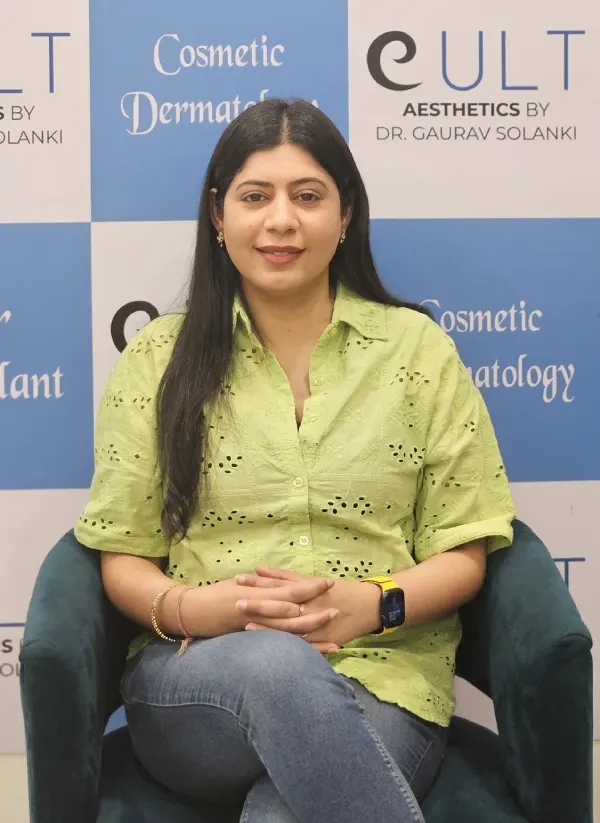
Dr. Jaspreet Gulati, MD (Dermatology) is the founder of Cult Aesthetics Dermatology in Sector 46, Gurgaon. With years of clinical experience in laser dermatology and a focus on evidence-based aesthetic medicine, she has built the practice around matched-wavelength laser care for Indian skin.
Want to see the machines we use day-to-day? Our laser hair removal in Gurgaon page lists the exact wavelengths, fluence ranges, and technology details plus the pricing tiers for every body area.
Related reading
- Laser Hair Removal in Gurgaon complete patient guide
- Laser Hair Removal Cost in Gurgaon area-wise pricing
- How many laser hair removal sessions do you really need?
- Choosing a Dermatologist in Sector 46, Gurgaon