
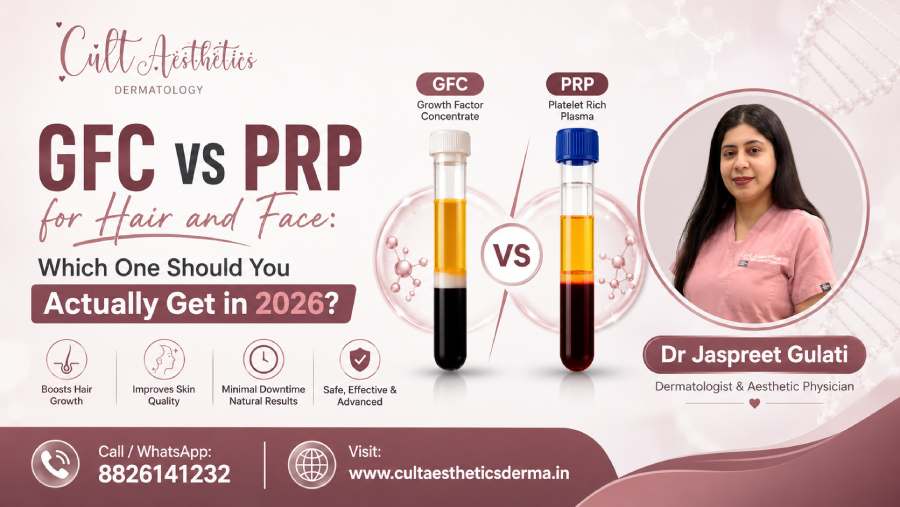
PRP and GFC are first cousins, not competitors. Both use growth factors from your own blood, both are used for hair restoration and skin rejuvenation, and both are safe when done by a qualified dermatologist. The honest difference: GFC is a more concentrated, processed version that delivers faster, more predictable results and costs about 60-80% more. For most patients in Gurgaon, the right answer depends less on which is “better” and more on what you’re treating, how aggressive your hair loss is, and your budget. This guide explains exactly how to decide.
[IMAGE: Side-by-side close-up of PRP vials (yellow-amber plasma) vs GFC tube (clearer concentrate) clinical setup]
What’s actually different between PRP and GFC?
Both start the same way: a small blood draw (usually 8-10 ml), spun in a centrifuge to separate the plasma. The difference is what happens next.
PRP (Platelet-Rich Plasma) stops there. The plasma fraction rich in platelets and the growth factors they release is drawn off and injected back. Platelet concentration is usually 3-5x baseline. You’re getting a mix: platelets, plasma proteins, white blood cells, and the growth factors locked inside the platelets.
GFC (Growth Factor Concentrate) takes that PRP and does an additional processing step. Through controlled activation, the platelets are made to release their growth factors before injection. What’s left is a pure liquid concentrate of growth factors PDGF, VEGF, EGF, FGF, IGF, TGF-β without the cellular debris. Growth factor concentration is typically 5-10x higher than standard PRP.
Think of it like coffee. PRP is whole brewed coffee. GFC is espresso pulled from the same beans same source, more concentrated, faster hit.
Which works better for hair loss?
For early to moderate hair thinning, both work. For aggressive hair loss or patients who’ve already plateaued on PRP, GFC tends to deliver clearer results in fewer sessions.
A 2022 comparative study published in the Journal of Dermatological Case Reports tracked patients across both treatments and found GFC produced superior gains in hair density and thickness, higher patient satisfaction, and fewer adverse effects. Clinic experience in India lines up with that data patients on GFC typically notice reduced shedding within 3-4 weeks; with PRP it’s closer to 6-8 weeks.
| Factor | PRP | GFC |
|---|---|---|
| Growth factor concentration | 3-5× baseline | 5-10× baseline (pure concentrate) |
| Hair fall reduction starts | 6-8 weeks | 3-4 weeks |
| Visible density change | 4-6 months | 3-4 months |
| Sessions for full course | 4-6 sessions, 4-6 weeks apart | 3-4 sessions, 4-6 weeks apart |
| Cost per session (Gurgaon, 2026) | ₹5,000-9,000 | ₹9,000-15,000 |
| Pain / downtime | Mild, downtime varies by patient and treatment | Mild, downtime varies by patient and treatment |
| Best for | Early thinning, budget-conscious, maintenance | Moderate hair loss, faster results, post-transplant support |
Which works better for skin?
This is where the conversation gets interesting in Gurgaon, because both treatments are excellent for skin rejuvenation and most clinics under-talk this use case.
On the face, the targets are different from the scalp: collagen production, dermal thickening, acne scar softening, fine line reduction, pigmentation evening, and overall glow. The growth factors that drive all of this work better when delivered as a pure concentrate (GFC) than as plasma + platelets (PRP), because cleaner concentration means less inflammation and a cleaner stimulation of fibroblasts.
Where PRP still holds ground: it’s also a “volumizing” treatment the plasma adds a small amount of biological volume, useful around the under-eye area and tear trough where you want both stimulation and a subtle plumping effect. PRP under-eye is sometimes called “vampire facial” and remains popular for this exact reason.
For acne scars, hyperpigmentation, and dull skin in Indian skin types, GFC combined with microneedling is the current dermatology standard. For under-eye dark circles and crepey neck skin, PRP is still excellent.
Most patients don’t actually need to choose. A typical year of skin maintenance combines GFC sessions for collagen building with one or two PRP sessions for under-eye support.
Is one safer than the other?
Both are extremely safe. The blood comes from you, so allergic reaction or rejection is essentially zero. Side effects, when they occur, are minor and short-lived: mild redness, slight swelling for 24-48 hours, occasional tenderness at injection sites.
The safety differences are practical, not biological:
- GFC has fewer reported side effects because the cellular fraction (which can drive mild inflammation) is removed during processing.
- PRP needs an experienced injector uneven distribution shows up as patchy results.
- Both require sterile technique. The risk you’re actually managing isn’t the treatment itself; it’s the centre’s hygiene standards.
The single biggest safety variable for both is who does it. A dermatologist-led procedure with proper centrifuge processing and aseptic technique is safe. Salon-style “PRP” with poor processing is where complications come from.
How much does PRP and GFC cost in Gurgaon?
Real 2026 pricing at dermatology clinics in Sector 46 and surrounding areas:
- PRP for hair: ₹5,000 – ₹9,000 per session. A standard course is 4-6 sessions, so ₹20,000 – ₹54,000 total.
- GFC for hair: ₹9,000 – ₹15,000 per session. A standard course is 3-4 sessions, so ₹27,000 – ₹60,000 total.
- PRP for face (vampire facial): ₹7,000 – ₹12,000 per session. Typically 3-4 sessions for a course.
- GFC for face: ₹10,000 – ₹16,000 per session. Typically 3-4 sessions.
- GFC + microneedling combo for acne scars: ₹12,000 – ₹18,000 per session.
Be careful of “starting from ₹2,500 PRP” advertised by some clinics in Delhi-NCR. At that price point, you’re either getting an unusually small blood volume, sub-clinical platelet concentration, or non-medical-grade processing. Real, effective PRP done by a dermatologist has a price floor.
Who should choose PRP, and who should choose GFC?
PRP is the right call for:
- Early hair thinning (recently started, less than 6 months of visible loss)
- Maintenance after a finished course of GFC or post-hair-transplant support
- Under-eye dark circles and tear-trough rejuvenation (because the plasma volume helps)
- Patients on a tight budget who still want medical-grade treatment
- Older patients with stable, slow-progressing thinning
GFC is the right call for:
- Moderate to noticeable hair loss where you want faster, clearer results
- Acne scars, post-acne marks, and skin texture issues paired with microneedling
- Patients who tried PRP and plateaued (a switch to GFC often restarts visible improvement)
- Pre- and post-hair-transplant scalp preparation and recovery
- Patients short on time who can’t fit 6 sessions into their schedule
- Skin glow and collagen-stimulation programmes for face, neck, and décolleté
What about combining the two?
This is where good dermatology shows up. A common Gurgaon protocol looks like this:
For hair: GFC × 3 sessions in months 1-3 to drive density, then PRP × 2 sessions in months 6 and 9 for maintenance. Total cost in the ₹50,000-70,000 range across a year, with better results than 6 PRP sessions back-to-back.
For face: GFC + microneedling × 3 sessions for acne scars / pigmentation / texture, then PRP under-eye × 2 sessions for dark circles. Total: ₹40,000-60,000 per year.
The mistake patients make is treating PRP and GFC as either/or. Treated as and, they’re complementary tools in a longer plan.
How Dr. Jaspreet Gulati approaches PRP and GFC at Cult Aesthetics Dermatology
Dr. Jaspreet Gulati is the founder of Cult Aesthetics Dermatology in Sector 46 Gurgaon, with a practice running since 2015 and a 4.9-star Google rating across 143+ reviews. Her approach to PRP and GFC is deliberately individualised there’s no “one size” protocol that gets applied to every patient.
A first consultation includes a hair-loss grading (Norwood for men, Ludwig for women), trichoscopy where indicated, and assessment of underlying factors (thyroid, ferritin, vitamin D, DHT-related issues). For skin, it’s a Fitzpatrick typing, photo-aging assessment, and acne scar grading where relevant. Only then does a treatment plan get drawn up and that plan often combines PRP, GFC, and adjunct therapies like minoxidil or microneedling rather than picking one in isolation.
What patients consistently say after switching: “I didn’t realise these treatments were so different from how they’re sold in other clinics.”
Frequently asked questions about PRP vs GFC
Will I see results in the first session?
No and any clinic that promises first-session results for PRP or GFC isn’t being honest. Both treatments work by stimulating biological processes (collagen production, follicle activation) that take weeks. Visible change typically starts in week 3-4 with GFC, week 6-8 with PRP. The full course needs to complete before you judge the result.
Is GFC just expensive PRP?
No. GFC has an extra processing step that isolates the growth factors from the cellular fraction. It’s a clinically different end product more concentrated, faster-acting, with fewer side effects. The price difference reflects the additional processing time and consumables, not a marketing markup.
How long do PRP and GFC results last?
For hair: 12-18 months from a finished course before you’d typically need a maintenance session. For skin: 6-12 months for the collagen-stimulation effect; the texture improvements last longer than the glow does. Both are not permanent treatments they’re maintenance interventions, similar to how you’d schedule dental cleanings.
Can I do PRP or GFC if I’m on blood thinners?
Caution please disclose this in consultation. Aspirin, clopidogrel, warfarin, and similar medications affect platelet function, which directly affects PRP/GFC efficacy. Many patients can still proceed safely, but the protocol may need adjusting or a brief pause in medication (cleared by your physician). Never stop blood thinners on your own without medical advice.
Is PRP or GFC safe during pregnancy?
Both are generally avoided during pregnancy and breastfeeding not because of documented harm (the substances are autologous), but because of insufficient research and a general precautionary principle in obstetrics. We’d recommend deferring elective PRP/GFC until after delivery and breastfeeding.
What’s the difference between GFC and “PRGF” or other branded growth-factor treatments?
Most “Plasma Rich in Growth Factors” or branded products are variations on the GFC concept different manufacturer protocols, sometimes different concentration ratios, but the underlying biology is the same. What matters more than the brand name is the processing standard at the clinic doing it.
Can I get PRP for one area and GFC for another in the same visit?
Yes, and this is increasingly common. For example, GFC on the scalp + PRP under the eyes in a single session. It requires slightly more blood (we’d draw 16-20 ml instead of 8-10 ml) and adds about 25-30 minutes to the procedure, but the cost-saving and convenience often make sense.
How do I know if PRP or GFC is genuinely being done correctly?
Three signs of a properly done procedure: (1) blood is drawn fresh on the day of treatment, not pre-processed; (2) you can see the centrifuge being used in the clinic; (3) the dermatologist or trained practitioner does the injections, not a junior aesthetician. Ask to see the kit being opened and the centrifuge in operation if you’re unsure.
Where can I book a consultation in Gurgaon?
Call or WhatsApp +91-88261-41232 to book a consultation at Cult Aesthetics Dermatology, Sector 46, Gurgaon. The first consultation is from ₹1,500 and includes a hair or skin assessment, treatment plan, and honest discussion of PRP, GFC, or combination protocols. You’re not pushed into a procedure the plan is yours to consider.