
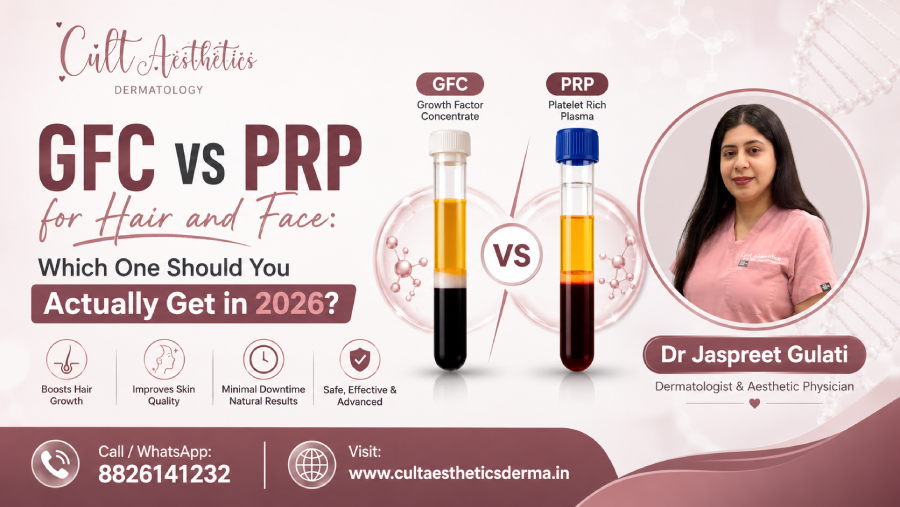
Short answer: PRP and GFC both use growth factors from a small sample of your own blood. PRP (platelet-rich plasma) contains platelets and plasma; GFC (growth factor concentrate) is processed one step further so the preparation is mainly growth factors, without most of the cells. For the face, both may be discussed for dull or uneven texture, early fine lines and some acne scars. Neither is right for everyone, and which one (if either) suits you depends on your concern, skin type, medical history and budget. At Cult Aesthetics Dermatology in Sector 46, Gurgaon, Dr. Jaspreet Gulati, MD (Dermatology) makes that recommendation only after examining your skin.
Clinical note: Suitability, side effects, number of sessions and results vary from person to person. This guide is educational and does not replace an in-person consultation.
How are PRP and GFC made?
Both start the same way: a small blood sample is drawn from your arm and spun in a centrifuge in the clinic.
- PRP stops there. The platelet-rich part of the plasma is separated and delivered back into the skin.
- GFC takes an extra processing step in which growth factors are released from the platelets and the cellular part is largely removed.
PRP vs GFC for face: side-by-side
| Factor | PRP | GFC |
|---|---|---|
| Source | Your own blood | Your own blood |
| What is delivered | Platelet-rich plasma (platelets, plasma, some other cells) | Growth factor concentrate, with most cells removed |
| How it is delivered on the face | Microneedling, fine injections, or both | Microneedling, fine injections, or both |
| Concerns sometimes discussed | Texture, early fine lines, selected acne scars, some under-eye concerns | Texture, early fine lines, selected acne scars |
| Common short-term effects | Redness, mild swelling, bruising, pinpoint marks for a few days | Redness, mild swelling, bruising, pinpoint marks for a few days |
| Sessions | Usually a course, set after assessment | Usually a course, set after assessment |
| Cost | Priced after assessment | Priced after assessment |
What does the evidence say?
Research on PRP for facial rejuvenation and acne scars is growing, but many studies are small, use different methods and report varied results. Evidence specifically comparing GFC and PRP on the face is more limited. Because of this, we do not present either as better for everyone. A more concentrated preparation does not automatically mean a better result for your skin.
Which may suit whom?
PRP may be discussed if:
- You want to start with a well-established option for skin texture or early fine lines
- You have selected acne scars and microneedling is being planned
- Certain under-eye concerns are being assessed (after the cause of dark circles is identified)
GFC may be discussed if:
- You and your dermatologist prefer a more processed, cell-reduced preparation
- Texture concerns or selected acne scars are being treated alongside microneedling
In some cases neither is the best choice, and another treatment such as a chemical peel, a different scar treatment or medical skincare may be recommended instead.
Who should avoid or delay PRP and GFC?
Treatment is usually avoided or delayed during pregnancy or breastfeeding, with active acne or a skin infection in the area, with certain blood or platelet disorders, or while on blood thinners. Tell us about every medicine and supplement you take. Do not stop any prescribed medicine unless the doctor who prescribed it advises you to.
Is one safer than the other?
Both are made from your own blood, so allergic reactions are unlikely, but no procedure is risk-free. Redness, swelling, bruising and small marks are common and usually settle within a few days. Less commonly, infection or temporary pigmentation changes can occur. Sterile technique and treatment by a qualified doctor matter for both.
What about PRP and GFC for hair?
This guide focuses on the face. For hair fall and thinning, read our separate GFC vs PRP hair treatment guide, or see our PRP for hair and GFC for hair pages.
Frequently asked questions: PRP vs GFC for face
Is GFC better than PRP for the face?
Not for everyone. GFC is more processed and contains fewer cells, but there is limited evidence that it gives better facial results than PRP. The right choice depends on your skin and is made after assessment.
Will I see results after the first session?
Usually not. Any change builds gradually over weeks and generally needs a course of sessions. Some people see limited change.
Are the results permanent?
No. Skin continues to age, and maintenance sessions may be discussed if you respond to treatment.
Can PRP and GFC be combined with other treatments?
Yes, sometimes. They are often combined with microneedling, and may be planned alongside peels or medical skincare after assessment.
How much do PRP and GFC for the face cost?
Both are priced after assessment, because the area, method and number of sessions vary. The consultation is free and there’s no obligation.
Book a face PRP or GFC assessment in Gurgaon
Learn more on our Face PRP & GFC Treatment in Gurgaon page, or call or WhatsApp +91-88261-41232 to book at Cult Aesthetics Dermatology, 4th Floor, BN. 67, Residency Green, Jal Vihar Colony, Sector 46, Gurugram. The first consultation is free, with no obligation and includes a skin assessment and an honest discussion of PRP, GFC, combination or alternative treatments. You’re not pushed into a procedure.
About the author
Dr. Jaspreet Gulati, MD (Dermatology), Founder, Cult Aesthetics Dermatology, Sector 46, Gurgaon. Practising since 2015, with a focus on cosmetic dermatology, acne and acne scars, and skin rejuvenation for Indian skin. Read full bio →
Related reading
- Face PRP & GFC Treatment in Gurgaon
- GFC vs PRP for Hair in Gurgaon
- Acne Scar Treatment in Gurgaon
- Chemical Peel Treatment in Gurgaon



One Response