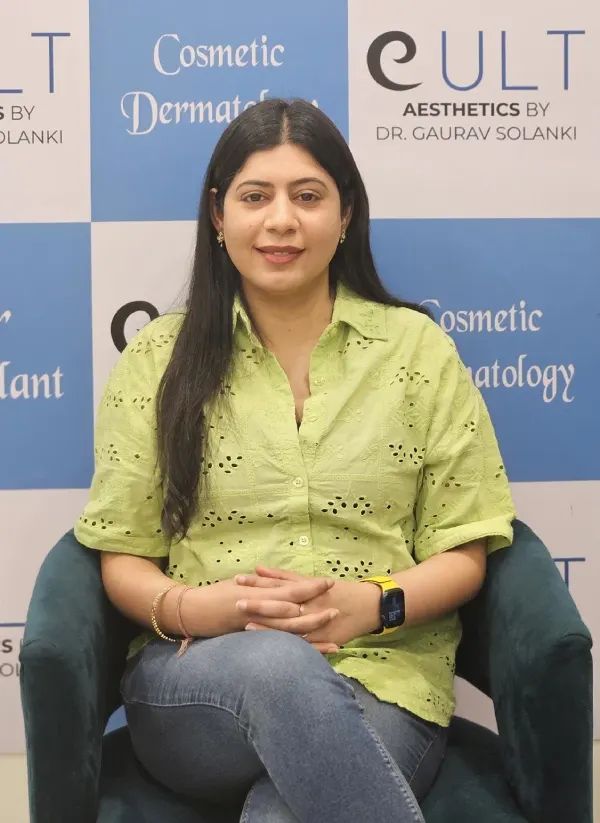

If you are looking into facial laser hair reduction in Gurgaon, it can be an option for hair on the chin, upper lip, jawline, sideburns and neck, but only after an individual assessment. For many women that assessment should include a question about hormones. This guide explains what to ask, how Indian skin changes the plan, how to prepare, and what to expect at Cult Aesthetics Dermatology in Sector 46.
TL;DR
- Facial hair is planned area by area, based on hair type, skin tone and hormonal history.
- In women, dark, coarse facial hair can have a hormonal cause such as PCOS. Laser reduces hair; it does not treat the cause.
- Darker or tanned skin carries a higher risk of burns and pigment change, so technique and settings matter.
- Expect several sessions, some regrowth and possibly maintenance. Your dermatologist decides the number and timing.
- Upper lip starts from Rs 2,000 per session. Other facial areas are quoted at consultation.
Which facial areas can laser hair reduction treat?
People most often ask about the chin and upper lip, then the jawline, sideburns and neck. At our clinic, hair on the upper lip, chin or sides of the face is a common reason for a laser enquiry, and availability for each area is confirmed at the consultation. A few coarse chin hairs and fine hair across the cheeks are different problems, so the plan is not copied from a leg or underarm package.
Results depend on hair colour, hair thickness, skin colour and the type of laser used (AAD laser hair removal FAQs). Very light or white hair may need other approaches, as your dermatologist will explain and for hirsutism the Endocrine Society suggests electrolysis for white or blonde hair (Endocrine Society hirsutism guideline).
In short: each area is planned on its own, and hair colour is one of the factors that decide whether laser suits you.
Could my facial hair be hormonal, and when should I get it checked?
In women, unwanted facial hair can have an underlying hormonal cause such as PCOS and may need a medical evaluation. The Endocrine Society suggests testing women with abnormal hirsutism scores, and the Indian guideline says laser will not prevent future hair growth from an underlying cause (Endocrine Society; IJDVL guideline).
That is why it helps to raise PCOS or any other health history at the first visit, even if you came only for the chin. Laser can be combined with medical treatment: the Endocrine Society says women with high androgen levels who choose hair removal should also receive drug therapy to reduce regrowth, and a 2024 systematic review found low-certainty evidence that adding medication to laser or IPL may help (2024 systematic review in PCOS). Any medication decision is for you and your doctor after evaluation.
In short: hormonal hair needs a medical question as well as a cosmetic one.
Is facial laser hair reduction suitable for Indian skin?
It can be an option, but it must be performed very carefully (AAD). Darker or tanned skin carries a higher risk of burns and pigment change, because melanin in the skin competes with melanin in the hair for the light energy (IJDVL). In darker skin, clinicians generally use longer-wavelength, long-pulse devices with skin cooling, with settings tailored to the person.
Evidence for laser in skin of colour is more limited than for lighter skin. A recent tan or sun exposure increases risk, so tell your dermatologist before treatment. A test patch can help set parameters and gauge comfort, although the Indian guideline calls it helpful rather than mandatory. More on skin-specific risks is in our guide to laser hair removal side effects for Indian skin.
In short: Indian skin can be treated, but tan, pigment and settings raise the stakes.
How should I prepare for chin or upper-lip laser?
Follow your clinic’s instructions to stop waxing, plucking and electrolysis in the area before treatment. Sources do not give one universal period, so ask how long your clinic wants you to wait (IJDVL). Threading removes hair from the root much as plucking does, so it is sensible to ask the clinic to treat it the same way. Hair is usually trimmed short or shaved, as the clinic advises.
Avoid tanning and sunless tanners, and use daily broad-spectrum, water-resistant sunscreen of SPF 30 or higher outdoors (AAD preparation guidance). Mention a tendency to scar, keloids, frequent cold sores and all medicines, including isotretinoin. Our preparation and aftercare guide has the full checklist.
In short: stop root-removal methods as advised, protect your skin from sun, and disclose your history.
What happens at the appointment, and how will it feel?
A consultation lets you discuss expectations, side effects, number of treatments and cost, and laser hair reduction is not right for everyone (AAD). Pain tolerance varies. Patients describe the pulses as warm pinpricks or a snapped rubber band, cooling is used, and a numbing gel applied 30 to 60 minutes before can help (AAD). Ask whether numbing cream is offered for your area. Use a numbing product only if your dermatologist recommends it, and apply it exactly as advised: the US FDA warns that numbing creams spread over large areas of skin or covered with wrap can cause serious side effects.
Afterwards, discomfort, swelling and redness are common and usually fade within 1 to 3 days. Less common effects include blistering, cold sore outbreaks, infection, scarring, and skin lightening or darkening. Avoid direct sun on treated skin, follow your dermatologist’s aftercare instructions, and tell the clinic promptly about persistent pain or blisters. See also is laser hair reduction painful.
In short: expect brief discomfort, and report anything that does not settle.
How many sessions will I need, and will the hair come back?
Several sessions are usually needed. The AAD gives 2 to 6 treatments on one page and 6 or more on another, so the number varies by person and cannot be fixed in advance (AAD overview). Your dermatologist decides when the next session is appropriate; see how many laser sessions are required.
Some hair usually regrows, but regrowth is typically finer, lighter and less noticeable, and maintenance sessions may be needed. Treatment can be repeated if hair regrows. The AAD notes that on a woman’s face, hormones mean hair reduction is not expected to last indefinitely, so hormone-linked facial hair may need ongoing maintenance. Laser aims for long-term hair reduction and should not be described as a promise of complete hair removal. Read about maintenance sessions after laser hair reduction.
In short: plan for a course, some regrowth and possible top-ups.
How much does facial laser hair reduction cost in Gurgaon?
Upper lip laser starts from Rs 2,000 per session. Other facial areas, such as the chin, jawline, sideburns and neck, are quoted at consultation. The laser consultation is Rs 500, adjusted against treatment if you go ahead, and packages are priced at consultation. For every area, see our laser hair removal cost in Gurgaon page.
| At a glance | Detail |
|---|---|
| Upper lip | Starting from Rs 2,000 per session |
| Chin, jawline, sideburns, neck | Quoted at consultation |
| Laser consultation | Rs 500, adjusted against treatment |
| Number and timing of sessions | Decided after assessment |
In short: only the upper lip has a published starting price; the rest depends on the area and your assessment.
Who should perform facial laser hair reduction?
The AAD recommends a board-certified dermatologist who is highly skilled with lasers, and warns that inexperienced operators can cause burns, scars and lasting colour changes (AAD). “Board-certified” is US terminology. The Indian guideline says a qualified dermatologist with training and hands-on experience in the device should perform it, and trained assistants may treat only under direct supervision, with the physician remaining responsible (IJDVL). Ask any clinic who will assess you and who is responsible. At Cult Aesthetics Dermatology, assessment and treatment planning is by Dr Jaspreet Gulati, MD (Dermatology). Our dermatologist review before laser guide lists more questions.
In short: ask who is responsible for your treatment before you pay for a course.
FAQ
Can laser cure PCOS facial hair?
No. Laser can reduce hair, but it does not treat the hormonal cause, and hormone-linked hair may need ongoing maintenance.
How many sessions does the upper lip or chin need?
Several are usually needed, and the number varies by person. Your dermatologist decides after assessment.
Can I thread or wax between sessions?
Ask your clinic first. Sources advise stopping waxing, plucking and electrolysis in the area before treatment, and the clinic will say for how long.
Is facial laser suitable for tanned or darker skin?
It can be an option when performed very carefully, but darker or tanned skin has a higher risk of burns and pigment change. Mention any recent sun exposure.
Should I see a doctor about hormones before starting?
It is worth raising. The Endocrine Society suggests testing women with abnormal hirsutism scores, and your dermatologist can advise whether an evaluation makes sense for you.
Next step: Book a dermatologist-led laser consultation at Cult Aesthetics Dermatology, 4th Floor, BN. 67, Residency Green, Jal Vihar Colony, Sector 46, Gurugram 122003. Call +91-88261-41232, message us on WhatsApp or use the contact page. For the full service overview, read laser hair removal in Gurgaon. The clinic also posts updates on Instagram and the Dermatology YouTube channel.
Results, suitability, session requirements and maintenance needs vary. Consult a qualified dermatologist for a personal assessment.